There are places where geography becomes destiny. The Andes, a 7,000-kilometre backbone still in motion, is one of them. East and west alike, it conditions, sculpts, and sometimes decides everything. The Cordillera of the Andes forges, constraint by constraint, two of the most singular wine regions in the world.
A living geology
Flying over the Andes is to understand at a single glance why these two wine regions differ so profoundly from the rest of the world. The expanse of snow and ice is almost intimidating. Yet it is from this wall of rock and glaciers that some of the most fascinating wines on the planet are born, on piedmont slopes and in interior valleys.
By geological standards, the Andes are young — barely 70 million years old, compared to 300 million for the Armorican Massif. They are still rising at 5 millimetres per year. Beneath them, the Nazca plate plunges under the South American continent at 7 to 8 centimetres annually, triggering earthquakes and volcanism. These geological convulsions have shaped today’s soils: colluvial deposits of pebbles and sand, and on the Chilean side, a remarkable wealth of volcanic metals — copper, lithium — that impart a mineral signature almost impossible to replicate elsewhere.
Its highest point, Aconcagua at 6,962 metres, towers over Mendoza’s finest terroirs. Paradoxically, its snowpack is also the lifeline of vineyards that receive as little as 200 millimetres of rain per year — half the conventional survival threshold. Without snowmelt channelled through acequias for centuries, not a single vine would survive in the province.
Two countries, two logics
The numbers speak for themselves. Chile is the world’s fourth-largest wine exporter by volume: 7.8 million hectolitres worth 1.7 billion dollars. Its vineyards stretch 4,300 kilometres from north to south — the equivalent of the distance from Stockholm to Tamanrasset. Every climate on the continent can be found here, from the Atacama Desert to the Patagonian fjords, which record up to 5,000 millimetres of rainfall a year. That diversity is both its greatest asset and its commercial challenge.
Argentina plays a different score. With 11.6 million hectolitres produced in 2024 — up 6.5% — and 205,000 hectares under vine, it is a wine power of a different scale. But its vineyard is both concentrated and extreme: over 80% of production comes from Andean zones, with Mendoza alone accounting for three quarters. More than 1,200 registered wineries. And viticulture climbing to 2,300 metres — a world record.
One of the most telling paradoxes of this region: Chile consumes little — 11 litres per capita — and exports massively to Brazil, China, the UK, the United States, and Japan. Argentina drinks more at home (17 litres per capita) but saw its exports fall 7% in 2024. Both regions are now asking the same question: how to move upmarket without losing their base.
Altitude is a quality argument
If only one factor could explain the rise of Andean wines, it would be this one. The Catena Institute of Wine places the threshold for “high-altitude wine” at 1,000 metres. Argentina has terroirs exceeding 2,300 metres — Gualtallary, Chacayes, Salta. Physics is unforgiving: temperature drops roughly 1°C for every 100 metres gained. At 1,500 metres, conditions are structurally cooler than in the valley below, regardless of daytime heat.
The diurnal range — the gap between sweltering days and near-freezing nights — is the biochemical engine of quality. Warm days drive photosynthesis and sugar ripeness. Cool nights slow berry respiration, preserving malic and tartaric acidity. This daily thermal ballet produces grapes with refined tannins, concentrated anthocyanins, and aromatic precision. The resulting wines are more defined, better balanced, and more age-worthy.
UV-B exposure, intensified by the thinner atmosphere at altitude, completes the picture. UV-B radiation stresses the vine, which responds by synthesising more protective polyphenols. The result: thicker skins, deeper colour, a naturally more evolved tannic structure. Mendoza’s vineyards above 1,000 metres confirm it with every vintage.
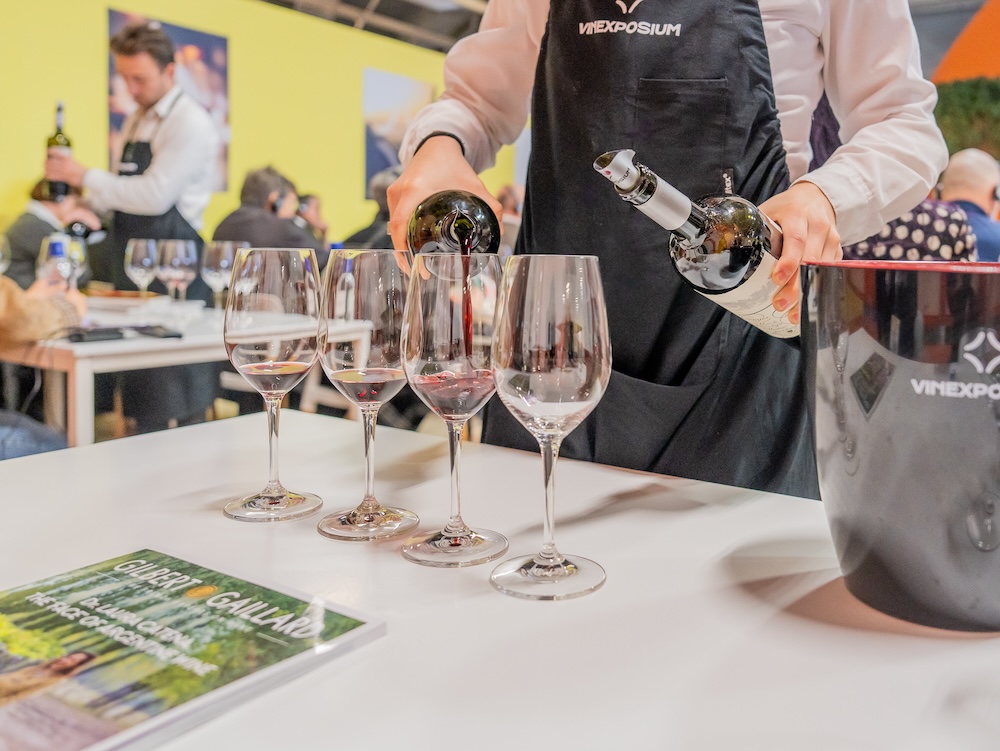
Water: The Open Question
The water question is perhaps the most urgent and least visible issue in Andean viticulture. Mendoza receives between 200 and 300 millimetres of rain per year. Desert climate. Without irrigation, not a single vine would survive. Its secret lies in the acequia networks — open-air canals inspired by Moorish Andalusian systems — that have distributed snowmelt to vine roots for centuries. Ingenious, fragile, indispensable.
But the horizon is darkening. Andean glaciers are retreating. Wells have been progressively banned from drilling in Mendoza. Drip irrigation, which saves between 40 and 60% of water, is becoming widespread but will not solve everything. In Chile, water rights are private and tradeable: a system that generates deep inequalities. Well-capitalised estates manage. Others, less certainly.
Paradoxically, controlled water stress remains a qualitative asset: it sharpens acidity, tightens tannins, and reduces fungal disease. Controlled irrigation is a form of terroir management that European vineyards, subject to the whims of rainfall, simply do not have. A real competitive advantage — as long as the resource holds.
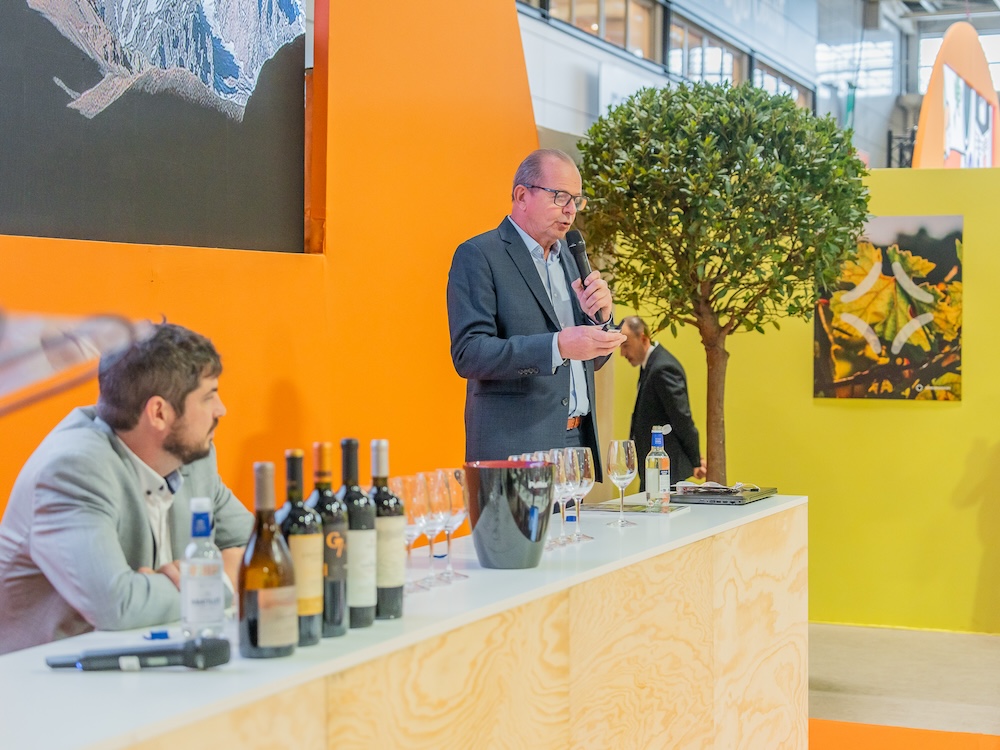
The Producers Redrawing the Map
Gualtallary may be the most exciting terroir in South America today. Located in the Uco Valley at 1,100 to 1,600 metres, it has an almost Burgundian precision. Its geological signature: the cemento indio, a layer of caliche — calcium carbonate — reaching up to 40% of surface composition in the Alto Gualtallary sector. Compacted soils force roots to plunge deep in search of water, yielding wines of rare mineral tension.
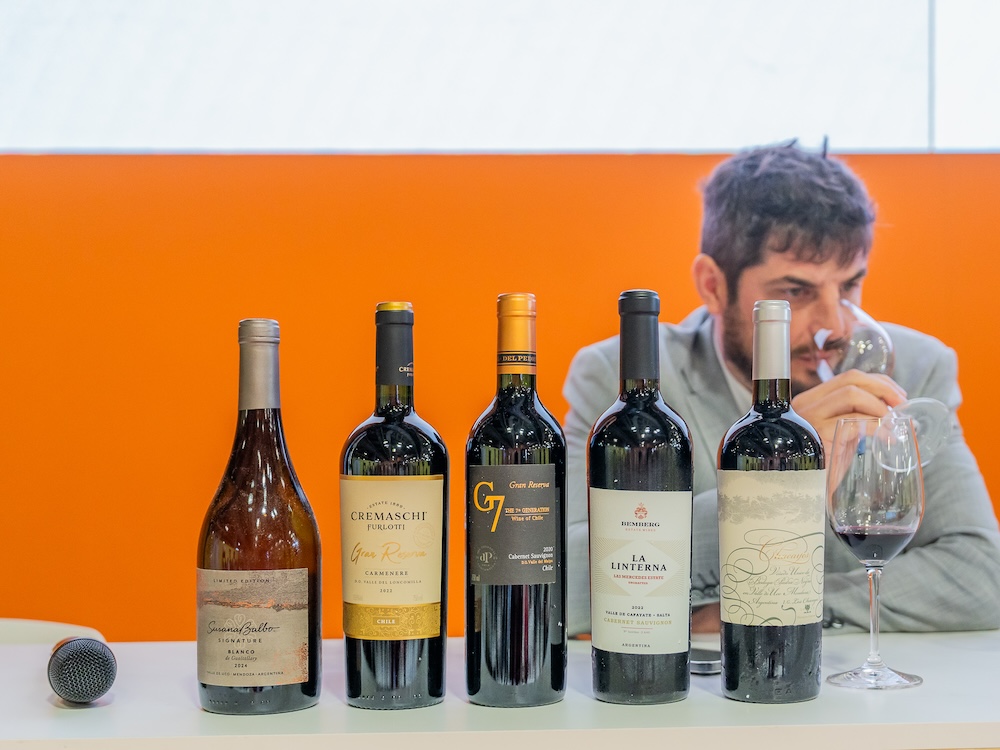
Susana Balbo, Argentina’s first woman to earn a winemaking degree (1981), produces her “Blanco de Gualtallary” there — a 100% Torrontés aged ten months in barrel that dismantles every preconception about this variety. The Torrontés Riojano, a cross between Muscat of Alexandria and Criolla, is supposed to be floral and charming but thin. At Gualtallary, at 1,300 metres, it gains density, tension, and length. 96 points at the Gilbert & Gaillard International Challenge.
To the north, in the province of Salta, Bemberg Estate Wines applies an estate vision reminiscent of the great Bordeaux châteaux: each wine comes from an identified terroir, worked as an autonomous entity. Their “La Linterna” Cabernet Sauvignon from Cafayate at 1,700 metres demonstrates what extreme altitude can give a variety often considered heavy elsewhere: nerve, precision, a freshness that low-altitude Cabernets struggle to achieve.
The Chacayes from Bodega Piedra Negra is, by a clear margin, the summit of this tasting. A 100% Malbec from Finca Los Chacayes, directly at the foot of the Cordillera at 1,100 metres, on alluvial soils. Twenty-four months in new French oak barrels. The result is striking: rare concentration without any heaviness, a crystalline freshness that belongs only to altitude, a tannin grain of near-Burgundian precision. 98 points at the Gilbert & Gaillard International Challenge. USD 120. This is the wine that proves, better than any argument, that the Uco Valley now plays among the very greatest.
On the Chilean side, the Maule Valley remains the historic heartland of the national vineyard. Cremaschi Furlotti, a family estate founded in 1889 by Italian immigrants and now run by the fourth generation, produces a Loncomilla Carménère Gran Reserva that perfectly illustrates Chilean identity: well-drained gravelly soils over volcanic moraines, concentrated fruit, serious tannins, 93 points for USD 25. The Maipo Valley, historic homeland of Chilean Cabernet, delivers a G7 Gran Reserva from Viña del Pedregal — nine generations since 1825 — that confirms the reliability of this benchmark terroir.
What Is at Stake Right Now
The future of Andean viticulture is being played out on three fronts. The first is hydric, as discussed. The second is identity. For too long, New World wines have been defined by their grape variety — “Argentine Malbec, Chilean Carménère” — a convenient but impoverishing shorthand. The current generation is working towards a terroir-driven approach and the creation of fine geographical indications — Gualtallary, Los Chacayes, Cafayate. That is the condition for these wines to become truly irreducible.
The third front is economic. In a global market where consumption is stagnating and competition between producing nations intensifying, price positioning remains decisive. Chile and Argentina have long won market share on value for money. They are now demonstrating, through their prestige cuvees — Chacayes at USD 120, Susana Balbo Signature at USD 85, Bemberg La Linterna at USD 100 — that they have the means to compete at the top table.
François Gilbert, co-founder of the Gilbert & Gaillard International Challenge, puts the prognosis with precision: “Provided water resources are sustainably managed, Andean viticulture is establishing itself as one of the most complete wine regions in the world. Capable of producing wines at scale and very great wines.” Both at once — that is the rare privilege of an extreme geography.
The Andes will continue to rise. Five millimetres a year. Imperceptibly. Viticulture will follow.